 Political Parties Database
Open-source database of political parties worldwide.
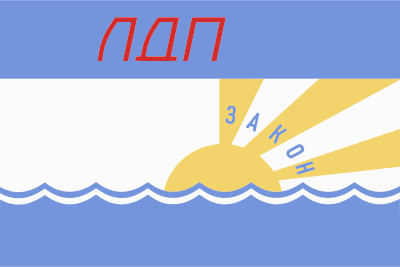
Liberal Democratic Party of the Soviet Union
Либерально-демократическая партия Советского Союза Liberal'no-demokraticheskaya partiya Sovetskogo Soyuza
In the summer of 1989, Vladimir Bogachyov left Lev Ubozhko's Democratic Party, which in turn had split from the Democratic Union in 1988 due to disagreement with its policies. Both Ubozhko and Bogachyov represented right-wing liberalism and conservatism. Toward the fall of 1989, Bogachev convened an initiative group to create a "liberal democratic party."
In late autumn, Vladimir Zhirinovsky, who had previously attempted to organize a "social democratic party of Russia" and even managed to develop a program for it, joined Bogachyov. This program was ultimately adopted as the basis, and the word "social" was replaced throughout with "liberal." According to the recollections of high-ranking KGB and CPSU Central Committee officials, with Zhirinovsky's arrival, the project became completely under the control of government officials and was formed at their instigation.
The formal first (founding) congress took place on 13 March 1990, at the Rusakov Palace of Culture, where the founding group received its official name, the "Liberal Democratic Party of the Soviet Union." According to recollections, this name was coined by representatives of the KGB's 5th Department shortly before the formal congress. Delegate cards, along with LDPSU membership cards, were distributed at the congress to anyone who wanted one. By the time of the first congress, the party had united 3,000 members across 31 regions of the Soviet Union. The party quickly received registration and the right to establish its own publication, the newspaper "Rech."
On 8 June 1990, Zhirinovsky and Vladimir Voronin (the future President of Moldova, PCRM) founded the "Centrist Bloc of Political Parties and Movements." During autumn 1990, the bloc held a series of consultations with Nikolai Ryzhkov on the possible formation of a so-called "government of national unity" with the CPSU.
On 6 October 1990, at Bogachyov's initiative, the Second (Emergency) LDPSU Congress was held in Moscow. Zhirinovsky was expelled from the party for collaborating with the KGB, and the party was renamed the "Liberal Democratic Party." In response, an all-Union LDPSU conference with congressional powers was convened on 20 October, chaired by Zhirinovsky. Zhirinovsky amended the party charter and expelled Bogachyov and his supporters.
Between late 1990 and early 1991, the party advocated for a state of emergency in the country and a temporary ban on all political parties. On 27 February 1991, the LDPSU participated in the "For a Great, United Russia!" conference organized by the Communist Party of the RSFSR.
On 12 April 1991, the party was formally registered by the USSR Ministry of Justice. That same year, Zhirinovsky nominated the party for the first direct presidential election in the RSFSR, finishing third with 7.81% of the vote.
During the August 1991 coup, Zhirinovsky and the LDPSU officially supported the putschists (GKChP) and welcomed their actions. After the coup's failure, the party's activities were suspended in Moscow, and the Ministry of Justice issued a warning to the party. The investigative group for the GKChP subsequently prepared charges against Zhirinovsky and the party for violating six articles of the Criminal Code, but these were never brought.
Several months after the collapse of the Soviet Union, the Third Congress of the Liberal Democratic Party was held in Moscow on 18-19 April 1992, attended by 627 delegates from 43 regions. The LDP was reorganized into the Liberal Democratic Party of Russia. Zhirinovsky was again elected party chairman.
In subsequent years, in addition to the LDPR, several similar liberal democratic parties were created in the post-Soviet space: - Liberal Democratic Party of Belarus, a splinter of Zhirinovsky's party, reorganized in 1994; - Liberal Democratic Party of Ukraine, independent of the LDPR, a group that had contacts with Bogachev's group in 1990, condemned the pro-Zhirinovsky coup of 1990, and retained a liberal and pro-Western orientation; - Liberal Democratic Party of Transnistria, previously the Transnistrian branch of the LDPR, reorganized into a separate party in 2006.
Chairman: Vladimir Bogachyov (13 December 1989 – 20 October 1990), Vladimir Zhirinovsky (20 October 1990 – 18 April 1992)
No source links have been entered in the spreadsheet.
suLDPSULast edited August 2026