 Political Parties Database
Open-source database of political parties worldwide.
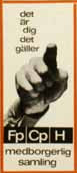
A Swedish right-wing party, which was formed in 1964 and was dissolved after the 1968 election. It aimed to increase cooperation between the right-wing parliamentary parties, which at that time consisted of the Centre Party, the People's Party and the Right Party. After the last election of the 1950s, the bourgeois parties had been in opposition despite having greater support in the electorate than the Social Democrats. This was because the Social Democrats had passive parliamentary support from the Communist Party of Sweden. But it was also believed to be due to the fact that the bourgeois votes were distributed between different parties and the idea was that cooperation or merger between them would increase the chances of defeating the Social Democrats.
In the aftermath of the 1968 election, MbS was dissolved and the majority of those active returned to their respective party organizations.
The Citizens' Coalition started as a pressure movement against the bourgeois parties, primarily in the Fyrstadskretsen constituency, pressure that was supported by the then leadership of Sydsvenska Dagbladet newspaper. However, there was no interest in such cooperation among the respective bourgeois party leaderships, and for this reason, MbS was constituted in April 1964 as an independent bourgeois electoral organization at a meeting in Lund by people who were already active in one of the existing bourgeois parties. In the 1964 election, the MBS list received strong support in the Fyrstadskretsen (27.8 percent of the votes in that constituency, corresponding to approximately 65,000 votes), which gave it three parliamentary seats, which were won by Bertil Rubin, Sten Sjöholm and Carl Göran Regnéll. By way of comparison, the Right Party and the People's Party each received one mandate in that constituency.
In 1965, Assembly for Progress was formed, which can be said to have been a national organization for the idea of a bourgeois coalition. Within this group, the idea of a completely new general bourgeois party began to gain more and more traction, and ahead of the 1966 municipal elections, bourgeois lists under a collective name were put up in several places in both the Fyrstadskretsen and outside Skåne (for example, "Assembly 66" in Gothenburg). In parallel with this, the bourgeois parties managed to negotiate electoral reforms with the Social Democrats that meant that the bourgeois vote split no longer had as much effect. With this, some of the incentives for the coalition movement disappeared.
Before this election, MbS failed to unite the three party leaderships in the Fyrstadskretsen and came to field several lists under the name Coalition 68. Due to personal and private conflicts in different rounds, the result was that voters in the constituency were given five electoral lists with different combinations of bourgeois members to decide on. After the 1968 election, the bourgeois retained the majority of its mandates, but the enthusiasm for cooperation under the name MbS had waned. In the aftermath of the election, MbS was dissolved and the majority of those active returned to their respective party organizations. However, a minority under the former MP Bertil Rubin started a new party, the Progress Party.
Chairperson: Carl Göran Regnéll
seMbSLast edited September 2026